Praxis Core Exam: 3-Month Study Framework for First Attempt Success
Anúncios
The 3-Month Study Framework to Pass the Praxis Core Academic Skills Exam on Your First Attempt is a vital topic for aspiring educators. This article delivers essential facts, verified insights, and what candidates need to understand now for effective preparation. It focuses on current, actionable strategies to achieve success.
The 3-Month Study Framework to Pass the Praxis Core Academic Skills Exam on Your First Attempt is emerging as a cornerstone for successful teacher certification in the United States. This comprehensive guide provides a structured pathway, outlining critical steps and resources. It emphasizes a strategic, consistent approach to maximize preparation efficiency and ensure a first-attempt pass.
This framework addresses the core components of the Praxis Core exam: Reading, Writing, and Mathematics. It is designed to demystify the preparation process, offering clarity and direction to candidates. Understanding this framework is crucial for anyone aiming to enter the teaching profession with confidence and a solid academic foundation.
Understanding the Praxis Core Academic Skills Exam
The Praxis Core Academic Skills Exam serves as a fundamental requirement for individuals pursuing teacher certification across many U.S. states. This examination assesses essential academic skills in reading, writing, and mathematics, which are deemed critical for success in an educator preparation program and in the classroom.
Administered by Educational Testing Service (ETS), the Praxis Core is not merely a hurdle but a benchmark for foundational academic proficiency. It ensures that prospective teachers possess the necessary skills to comprehend complex texts, articulate ideas effectively, and solve mathematical problems accurately, all vital for effective instruction.
Anúncios
Candidates often face challenges in balancing their study efforts across these diverse subjects. A structured approach, such as the Praxis Core Study Framework, becomes indispensable for managing time and resources effectively. This framework helps in prioritizing content areas and developing a cohesive study plan that mitigates common pitfalls.

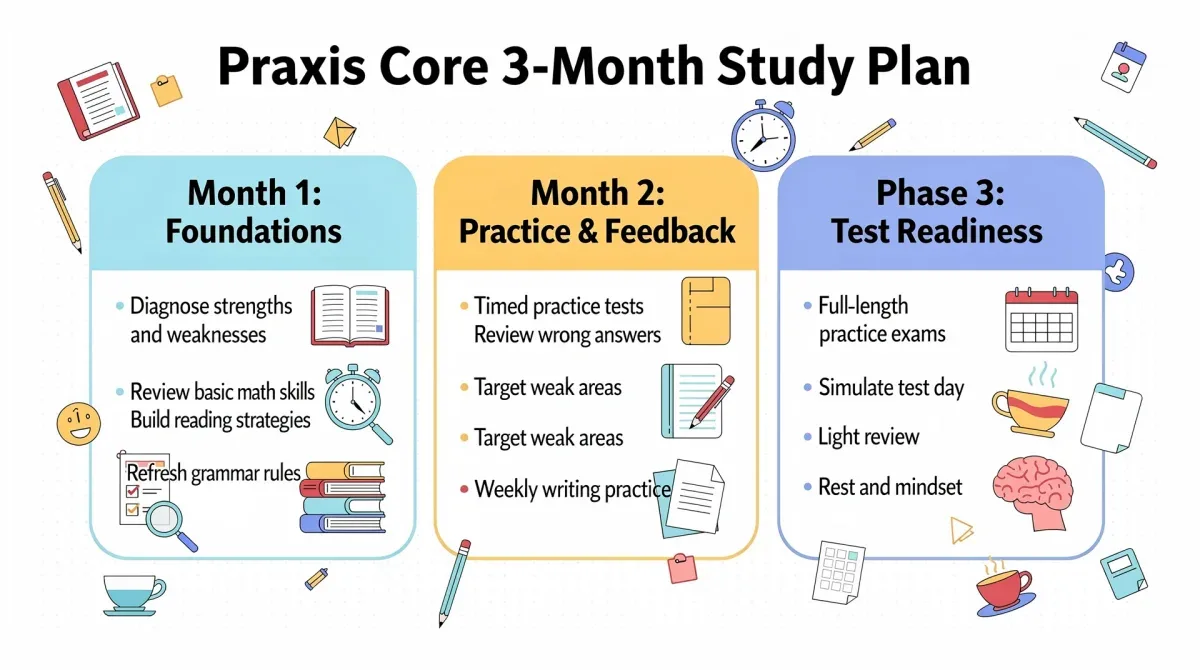
Phase 1: Diagnostic Assessment and Resource Gathering (Month 1)
The initial phase of the Praxis Core Study Framework focuses on understanding your current knowledge level and assembling the necessary study materials. This diagnostic approach helps identify strengths and weaknesses early on, allowing for a more targeted study plan. It is a critical step in avoiding generic study methods that may not address individual needs.
Begin by taking a full-length practice test under timed conditions. This initial assessment provides a realistic baseline of your performance across all three sections: Reading, Writing, and Mathematics. Analyzing the results will highlight specific areas requiring significant attention, forming the foundation of your personalized study strategy.
Simultaneously, gather all official study guides, practice books, and online resources provided by ETS or reputable educational platforms. These materials are designed to align with the exam's content and format, ensuring that your study efforts are relevant and effective. Access to quality resources is paramount for the Praxis Core Study Framework.
Identifying Strengths and Weaknesses
Upon completing your diagnostic test, meticulously review every incorrect answer to understand the underlying concepts you struggled with. Categorize these errors by subject and specific topic areas, such as algebra, geometry, grammar, or reading comprehension strategies. This granular analysis is key to efficient study.
Focusing on areas of weakness early in the Praxis Core Study Framework allows for ample time to build foundational knowledge and practice difficult concepts. Conversely, reinforcing strengths ensures that you maintain proficiency in areas where you already perform well, preventing any decline in performance.
- Analyze diagnostic test results thoroughly.
- Categorize errors by subject and specific topic.
- Prioritize weak areas for intensive study.
Assembling Your Study Toolkit
Your study toolkit should include official ETS study guides, which offer detailed content outlines and sample questions. Supplement these with reputable third-party resources known for their comprehensive explanations and additional practice opportunities. Ensure these resources align with the current exam specifications.
Anúncios
Consider utilizing online platforms that offer interactive lessons, video tutorials, and additional practice tests. Many platforms provide personalized feedback and progress tracking, which can be invaluable throughout the Praxis Core Study Framework. A diverse toolkit ensures multiple perspectives on challenging topics.
Do not overlook the importance of flashcards for vocabulary and mathematical formulas. Creating your own study materials, such as summary notes or concept maps, also enhances retention. A well-curated study toolkit is a cornerstone of effective preparation for the Praxis Core.
Phase 2: Targeted Content Review and Skill Building (Month 2)
The second month of the Praxis Core Study Framework is dedicated to an in-depth review of content areas identified as weak points and systematic skill building. This phase involves active learning techniques, rather than passive reading, to ensure deep comprehension and application of knowledge. It is where theory transforms into practical ability.
Allocate specific study blocks to each subject, ensuring a balanced approach while giving extra time to challenging areas. For mathematics, this might involve reviewing fundamental concepts like algebra, geometry, and data analysis. For reading, focus on inferencing, main idea identification, and understanding complex texts.
In writing, practice essay construction, grammar rules, and sentence structure. The goal is not just to understand the material but to apply it effectively under exam conditions. Consistent practice during this phase is crucial for the Praxis Core Study Framework.
Deep Dive into Mathematics
Mathematics often presents a significant challenge for many test-takers. Dedicate substantial time to revisiting core mathematical concepts, from basic arithmetic and fractions to more advanced topics like probability and statistics. Utilize practice problems extensively to solidify your understanding and improve problem-solving speed.
Break down complex problems into smaller, manageable steps. Understanding the process behind solving a problem is often more beneficial than simply memorizing formulas. The Praxis Core Study Framework emphasizes conceptual understanding over rote memorization to tackle diverse problem types.
Engage with video tutorials and step-by-step guides for topics that remain particularly difficult. Working through examples and then attempting similar problems independently helps reinforce learning. Consistent practice builds both accuracy and confidence for the Praxis Core exam.
Mastering Reading Comprehension
The reading section assesses your ability to analyze and interpret various types of texts. Practice active reading techniques, such as annotating passages, identifying main ideas, and discerning author's purpose. Work on distinguishing between fact and opinion, and understanding inferential questions.
Regularly read diverse materials, including academic articles, news editorials, and literary excerpts, to broaden your exposure to different writing styles and complex vocabulary. This broad exposure will enhance your speed and comprehension during the actual exam. The Praxis Core Study Framework encourages a wide reading habit.
- Practice active reading strategies like annotation.
- Focus on identifying main ideas and author's purpose.
- Read diverse texts to improve speed and comprehension.
Enhancing Writing Skills
The writing section requires both selected-response questions on grammar and usage, and two essay tasks. For the essays, focus on developing clear thesis statements, organizing paragraphs logically, and supporting arguments with relevant evidence. Practice writing timed essays to improve speed and coherence.
Review fundamental grammar rules, punctuation, and sentence structure. Many resources offer exercises specifically designed to target common writing errors. Consistent practice in both grammar and essay writing is vital for success in this section of the Praxis Core Study Framework.
Seek feedback on your practice essays from peers or mentors, if possible. An external perspective can highlight areas for improvement that you might overlook. Refining your writing skills incrementally will build confidence for the exam.
Phase 3: Practice Tests and Final Review (Month 3)
The final month of the Praxis Core Study Framework is dedicated to extensive practice testing and a comprehensive review of all subject areas. This phase simulates actual exam conditions, helping you to manage time effectively and reduce test anxiety. It is about fine-tuning your strategies and solidifying your knowledge.
Take at least two full-length practice tests under strict timed conditions to mimic the real exam environment. Pay close attention to pacing yourself through each section, especially the mathematics and writing components. This practice helps build stamina and familiarity with the test format.
After each practice test, conduct a thorough review of both correct and incorrect answers. Understand why certain answers were right and where your reasoning went astray for the wrong ones. This analytical approach is crucial for identifying lingering weaknesses and making final adjustments to the Praxis Core Study Framework.
Simulating Exam Conditions
Creating an authentic exam environment for your practice tests is critical for accurate self-assessment. Find a quiet space, set a timer for each section, and avoid distractions. Treat these practice sessions as if they were the actual Praxis Core exam to truly gauge your readiness.
Familiarize yourself with the on-screen calculator provided for the mathematics section. Practice using it efficiently to save time during the exam. Understanding the interface and functionality beforehand can prevent unnecessary delays on test day, an important aspect of the Praxis Core Study Framework.
- Take full-length practice tests under timed conditions.
- Eliminate distractions to simulate the real exam.
- Practice using the on-screen calculator for mathematics.
Targeted Review and Final Adjustments
Utilize the results from your practice tests to guide your final review. Revisit any content areas where you consistently make mistakes or feel less confident. Focus on reinforcing these weaker points rather than broadly reviewing everything, which can be inefficient during this crucial final month.
Create concise cheat sheets or flashcards for key formulas, grammar rules, and reading strategies that you find yourself forgetting. These quick reference tools can be invaluable for last-minute review sessions. The Praxis Core Study Framework emphasizes efficiency in the final stages.
Prioritize sleep and stress management in the days leading up to the exam. A well-rested mind performs better under pressure. Trust in the preparation you have undertaken over the past three months and approach the exam with a calm and focused mindset, confident in your Praxis Core Study Framework.
Effective Strategies for Each Section
Mastering the Praxis Core requires specific strategies tailored to each of its three distinct sections. A one-size-fits-all approach often falls short, highlighting the importance of targeted preparation. Understanding the nuances of each section is a key component of the Praxis Core Study Framework.
For the Reading section, focus on identifying main ideas, understanding vocabulary in context, and drawing inferences. Practice active reading by highlighting key points and summarizing paragraphs mentally. Time management is crucial, as passages can be lengthy and complex.
In the Writing section, pay close attention to grammar, usage, and sentence structure for the selected-response questions. For the essays, develop a clear thesis, organize your thoughts logically, and provide strong supporting evidence. Adhering to the prompt is paramount for a high score, reinforcing the Praxis Core Study Framework.
Reading Section Tactics
When approaching the Reading section, prioritize understanding the overall structure and main argument of each passage before diving into specific questions. Many questions can be answered by identifying the author's purpose or the central theme, rather than getting lost in minor details. This high-level comprehension saves time.
For vocabulary questions, always look for contextual clues within the passage. Even if you don't know the exact definition of a word, the surrounding text often provides enough information to make an educated guess. This strategy is critical for efficient progress within the Praxis Core Study Framework.
Practice skimming passages for general understanding and then re-reading specific sections for detailed answers. This dual approach helps you to quickly locate relevant information without reading every word exhaustively. Consistent practice with various text types will improve your speed and accuracy.
Writing Section Best Practices
For the selected-response questions in the Writing section, review common grammatical errors such as subject-verb agreement, pronoun usage, and parallelism. Practice identifying these errors in sentences and correcting them. A strong grasp of fundamental grammar rules is non-negotiable.

When tackling the essays, dedicate a few minutes to outlining your points before you start writing. A clear outline ensures logical flow and coherence, which are heavily weighted in the scoring. Ensure your thesis statement is explicit and that each body paragraph supports it directly, a core tenet of the Praxis Core Study Framework.
- Review grammar rules and practice error identification.
- Outline essays to ensure logical flow and clear thesis.
- Support arguments with relevant and specific evidence.
Mathematics Section Techniques
In the Mathematics section, focus on understanding the underlying concepts rather than just memorizing formulas. While some formulas are helpful, the ability to apply mathematical reasoning to various problem types is more critical. Practice a wide range of problems, from basic arithmetic to algebraic equations and geometric principles.
Utilize the on-screen calculator strategically. Know when it's beneficial to use it and when mental math or estimation is quicker. Over-reliance on the calculator can sometimes slow you down. The Praxis Core Study Framework encourages smart calculator usage.
Break down word problems into smaller, more manageable parts. Identify the given information, what is being asked, and the operations needed to solve the problem. Drawing diagrams or models can often help visualize complex problems and lead to the correct solution. Consistent practice is key to success in the Praxis Core Study Framework.
Managing Test Anxiety and Maintaining Motivation
Test anxiety can significantly hinder performance, even for well-prepared candidates. Incorporating strategies to manage stress and maintain motivation is an integral part of the Praxis Core Study Framework. A calm and focused mindset is as important as content knowledge on exam day.
Practice mindfulness techniques, such as deep breathing or short meditation sessions, to calm your nerves before and during study sessions. Regular physical activity can also help reduce stress and improve mental clarity. These habits contribute to overall well-being and better cognitive function.
Set realistic goals and celebrate small victories throughout your three-month journey. Breaking down the study process into manageable chunks makes the overall task less daunting and helps sustain motivation. Remember your ultimate goal: passing the Praxis Core Academic Skills Exam on your first attempt.
Strategies for Stress Reduction
Developing a consistent routine that includes study, relaxation, and physical activity can significantly reduce stress levels. Avoid cramming, especially in the days leading up to the exam, as this often increases anxiety and diminishes retention. The Praxis Core Study Framework promotes a balanced approach.
Practice positive self-talk and visualize success. Believing in your ability to pass the Praxis Core can significantly impact your confidence and performance. Surround yourself with supportive individuals who encourage your efforts.
- Incorporate mindfulness and deep breathing exercises.
- Maintain a consistent routine with study and relaxation.
- Practice positive self-talk and visualize success.
Sustaining Motivation Throughout the Framework
To sustain motivation over three months, regularly remind yourself of your ultimate goal: becoming a certified teacher. Connect your daily study efforts to this larger aspiration. This intrinsic motivation is a powerful driver for consistent engagement with the Praxis Core Study Framework.
Consider joining a study group or finding an accountability partner. Sharing challenges and successes with others can provide encouragement and fresh perspectives. Collective learning environments often boost morale and reinforce commitment to the study plan.
Vary your study methods to prevent burnout. Incorporate different resources, practice test formats, and study environments. Keeping your study routine dynamic helps maintain interest and prevents monotony, ensuring you stay on track with the Praxis Core Study Framework.
Leveraging Online Resources and Study Groups
In today's digital age, a plethora of online resources and virtual study groups can significantly enhance your Praxis Core Study Framework. These tools offer flexibility, diverse learning materials, and opportunities for collaborative learning. Utilizing them effectively can provide a significant advantage in your preparation.
Official ETS resources, including their website and practice tests, are invaluable for understanding the exam's format and content. Beyond official sources, many reputable educational platforms offer comprehensive courses, video lessons, and adaptive practice questions tailored to the Praxis Core. These can complement your primary study materials.
Joining online forums or virtual study groups connects you with other candidates who are also navigating the Praxis Core. This community can provide peer support, share effective strategies, and clarify difficult concepts. Collaborative learning is a powerful component of the Praxis Core Study Framework.
Utilizing Digital Platforms for Practice
Digital platforms often provide diagnostic tools that track your progress and identify areas needing more attention. These adaptive learning systems can personalize your study path, focusing on your specific weaknesses. This targeted approach is highly efficient for maximizing study time.
Many platforms offer timed practice tests that simulate the actual exam experience, complete with score reports and detailed answer explanations. Regularly engaging with these digital practice tests helps improve time management and reduces test-day anxiety, crucial elements of the Praxis Core Study Framework.
- Leverage adaptive learning platforms for personalized study.
- Engage with timed digital practice tests regularly.
- Utilize detailed answer explanations to understand mistakes.
Benefits of Collaborative Learning
Study groups offer a dynamic environment where you can discuss challenging topics, explain concepts to others, and gain new perspectives. Teaching a concept to someone else is a highly effective way to solidify your own understanding and identify any gaps in your knowledge. This active engagement is invaluable.
Collaborating with peers can also provide a strong support system, helping to mitigate feelings of isolation or overwhelm during intensive study periods. Sharing tips, resources, and encouragement can boost morale and keep everyone motivated to adhere to the Praxis Core Study Framework.
Ensure your study group remains focused and productive by setting clear agendas for each session. Assign specific topics for discussion and come prepared with questions or explanations. A well-structured study group can be a powerful asset in your Praxis Core preparation.
Key Takeaways for First Attempt Success
Achieving success on the Praxis Core Academic Skills Exam on your first attempt hinges on a well-executed Praxis Core Study Framework. This involves a strategic blend of diagnostic assessment, targeted content review, extensive practice, and effective anxiety management. Each phase builds upon the last, creating a cohesive and powerful preparation plan.
The initial diagnostic assessment is not just a formality; it is the compass guiding your entire study journey. Identifying specific areas of weakness allows for concentrated effort where it is most needed, preventing wasted time on already mastered concepts. This precision is a hallmark of an effective Praxis Core Study Framework.
Consistent practice, particularly under timed conditions, is paramount. It familiarizes you with the exam format, improves pacing, and builds the stamina required for a multi-hour test. Coupled with robust content review and a positive mindset, this framework significantly increases your chances of passing the Praxis Core on your first try.
| Key Point | Brief Description |
|---|---|
| Diagnostic Assessment | Start with a practice test to pinpoint strengths and weaknesses. |
| Targeted Content Review | Focus on improving weak areas identified in the diagnostic phase. |
| Extensive Practice | Simulate exam conditions with multiple full-length practice tests. |
| Mindset & Motivation | Manage anxiety and maintain focus throughout the 3-month period. |
Frequently Asked Questions About the Praxis Core Study Framework
What is the ideal duration for studying for the Praxis Core Exam?▼A three-month study period is widely considered ideal for the Praxis Core Academic Skills Exam. This duration allows for comprehensive content review, ample practice testing, and sufficient time to address individual weaknesses without feeling rushed. It balances thoroughness with manageability for most candidates.
How important is the diagnostic test in the study framework?▼The diagnostic test is critically important as it provides a baseline assessment of your current knowledge and pinpoints specific areas of weakness. This initial evaluation guides your entire study plan, ensuring your efforts are targeted and efficient, which is a core principle of the Praxis Core Study Framework.
Can I pass the Praxis Core without a formal study framework?▼While some individuals might pass without a formal framework, a structured approach like the 3-Month Study Framework significantly increases your chances of success on the first attempt. It provides organization, ensures all content areas are covered, and helps manage time and stress effectively, making preparation much more reliable.
What resources are essential for this study framework?▼Essential resources include official ETS study guides, full-length practice tests, and reputable online platforms offering video lessons and adaptive practice. A diverse set of materials provides varied explanations and ample opportunities for skill reinforcement, ensuring a robust Praxis Core Study Framework.
How do I manage test anxiety during the preparation process?▼Managing test anxiety involves incorporating stress-reduction techniques like mindfulness and regular physical activity into your routine. Consistent practice tests under timed conditions also build confidence and reduce anxiety by familiarizing you with the exam environment. Trusting your Praxis Core Study Framework preparation is key.
What this means
The implementation of a well-defined Praxis Core Study Framework is not merely a suggestion but a strategic imperative for aspiring educators. This structured approach helps demystify a critical examination, offering a clear path to success. The ongoing emphasis on comprehensive, yet manageable, preparation underscores the evolving standards in teacher certification. Future developments will likely continue to highlight the importance of such frameworks in ensuring candidates are not only knowledgeable but also adept at test-taking strategies. This proactive preparation contributes significantly to a stronger educational workforce nationwide.